
Global advertising spend is projected to surpass the $1 trillion mark in 2025 — reaching between $1.08 trillion and $1.14 trillion worldwide.
Digital advertising commands the majority of this budget.
But as spending increases, so does a growing invisible cost:
Ad fraud.
Often described as a “hidden tax” on the digital ecosystem, ad fraud is no longer a marginal issue. It is now one of the largest systemic inefficiencies in modern marketing.
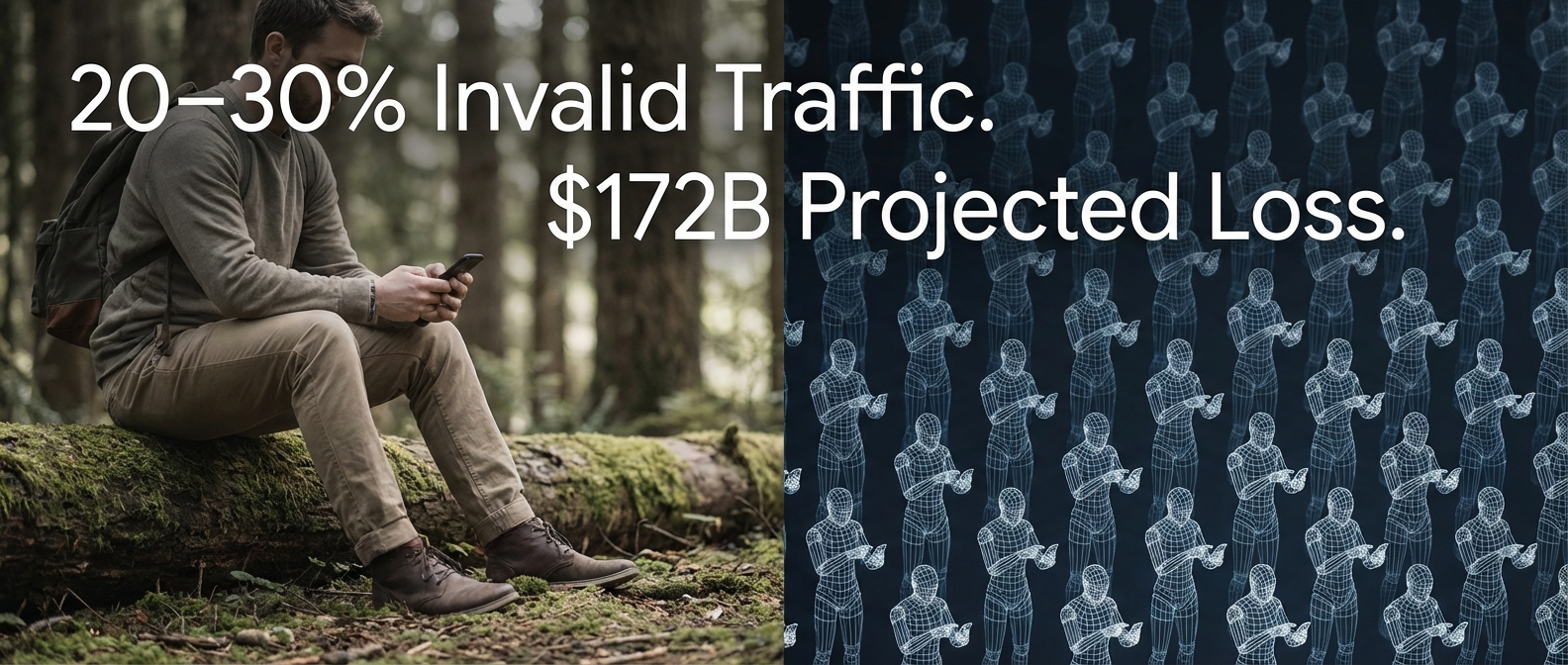
By 2028, global digital ad fraud losses are projected to reach $172 billion.
And significant milestones will already have been exceeded by 2025.
Programmatic & CTV Vulnerability
Programmatic advertising remains one of the most exposed channels.
In 2025, a significant share of Connected TV (CTV) and video inventory is impacted by spoofing — where ads are served in the background or on fabricated inventory, never seen by real humans.
Advertisers believe they are buying premium placement.
Instead, they are funding invisible impressions.
Mobile App Fraud
As mobile app advertising expands, fraud tactics such as:
SDK spoofing
Click injection
Click spam
continue to drain budgets.
Fraud-as-a-Service (FaaS)
The rise of FaaS platforms has lowered the barrier to entry for cybercriminals.
Sophisticated fraud tools are now sold as subscription services.
Ad fraud has industrialised.
Regional & Sectoral Impact
Certain sectors are disproportionately affected.
Banking, Financial Services & Insurance (BFSI)
Telecom
Education lead generation
These industries experience invalid traffic rates up to 32% higher than e-commerce.
Regionally:
India is seeing roughly 10% of digital ad budgets lost to fraud.
In the GCC region, an estimated $312 million in 2025 ad spend is forecasted to be wasted — largely across major digital platforms.
Performance Breakdown
Across 30 days:
1,587 verified QR scans
Consistent daily engagement
Repeat scan clusters in key zones
Engagement distributed across multiple districts
That equates to:
~158 measurable interactions per bike
~5+ verified engagements per bike per day
In out-of-home terms, that is not passive awareness.
That is conversion-level interaction.
The Defense Response
Platforms are not standing still.
Google suspended over 39 million accounts in 2024 using AI-based fraud detection.
Industry initiatives like the Trustworthy Accountability Group (TAG) have shown measurable impact, with some reports indicating a 69% reduction in potential fraudulent losses for European advertisers adopting stricter standards.
Detection technology is improving.
But here’s the challenge:
As digital ad volume grows, even a smaller fraud percentage results in larger absolute losses.
What This Means for Advertisers
The 2025 outlook is clear:
Fraud detection is improving.
But the scale of digital spending ensures fraud remains systemic.
As programmatic, AI-driven, and automated advertising ecosystems expand, complexity increases — and with it, exposure.
For brands, the question becomes:
Where can measurable engagement occur in environments less vulnerable to automation and spoofing?
Strategic Perspective
Digital advertising will continue to dominate global spend.
But physical-world, movement-based media offers something digital ecosystems struggle with:
Verifiable human exposure.
When combined with structured tracking systems, physical deployments provide accountability without dependence on opaque digital supply chains.
As fraud grows more sophisticated, advertisers will increasingly value:
Transparency
Verifiable engagement
Controlled inventory
Direct reporting
The trillion-dollar advertising era demands measurable infrastructure — not just digital impressions.